




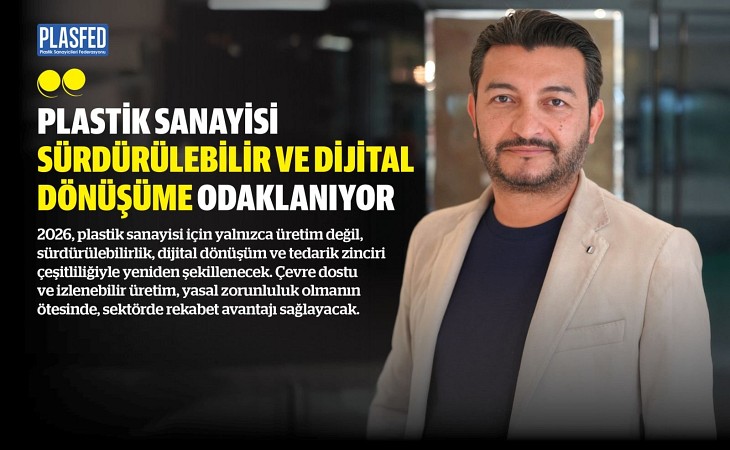
2026 will be reshaped for the plastics industry not just by production, but by sustainability, digital transformation, and supply chain diversification. Eco-friendly and traceable production will go beyond being a legal requirement and will provide a competitive advantage in the sector.
Kağan YEŞİL
Bursa Plastics and Packaging Industrialists Association (BURPAS)
Chairman of the Board
For the plastics industry, particularly for companies operating in the field of packaging and bag production, 2026 will be a period where not only production targets but also transformation strategies will be redefined. Increasing global environmental sensitivity, rapid changes in European Union legislation, volatility in energy costs, and vulnerabilities in supply chains are forcing our sector to move beyond the traditional understanding of production.
In 2026, the biggest priority for the plastics industry will undoubtedly be sustainability. Globally, governments and consumers are making stricter demands due to the harm caused by plastic waste to the environment. For instance, it is stated that the certified circular plastic market reached a volume of $2.03 billion in 2025 and is projected to grow at an annual rate of 11% until 2035. This represents a huge opportunity for packaging manufacturers like us.
The European Union's Plastics Strategy and the regulations of the Ministry of Environment in Turkey are increasing recycling requirements for plastic packaging. In 2026, the transition to non-phthalate plasticizers will accelerate, as traditional phthalates are falling out of favor due to health and environmental risks. According to market reports, the plasticizer market is expected to reach $106.19 billion in 2026, with most of this growth coming from bio-based and eco-friendly alternatives. At our company, we are moving away from fossil-based raw materials by investing in bioplastic bag production. The priority is to make the supply chain circular: ensuring traceability from raw material to the final product. This is not just legal compliance; it is also a competitive advantage.
The power of digital transformation is growing
The plastics industry will survive in 2026 through technological innovations. Automation and AI are balancing labor costs while increasing production efficiency. In the US plastics industry, it is stated that automation has become the norm in high-volume production; this is supported by smart machines, robots, and vision systems.
Additionally, material innovations are critical. Lightweight, durable, and recyclable packaging is in demand. Across the sector, innovations such as 3D printing and nano-technologies will enable personalized production. However, finding financial resources for these investments must be a priority; government incentives and EU funds come into play here.
Supply chain must be diversified
Global trade wars and tariffs will affect the plastics industry in 2026. In the US, it is emphasized that tariffs put the demand for plastics in durable goods at risk. Similarly, in Turkey, dependency on imported raw materials increases costs. The priority is to diversify the supply chain: shifting from Asia to Europe provides protection against geopolitical risks.
In the packaging sector, a "perfect storm" is occurring where PCR imports are putting pressure on the domestic market. Policy incentives are essential to expand the recycling market in 2026. Governments imposing minimum PCR content requirements will boost demand. Our strategy is to enter into long-term contracts with suppliers and optimize inventory management with AI. There are economic growth opportunities; however, inflation and energy costs should not be ignored.
There is demand for sustainable packaging
Finally, consumer demands will determine 2026 priorities. The demand for sustainable packaging is increasing; brands are turning to eco-friendly bags. The plastic market is expected to grow at a CAGR of 2.5%, but segmentation is important.
International agreements like the UN Global Plastics Treaty will transform our sector. This makes managing the plastic life cycle mandatory. The priority is market research and rapid adaptation.
This content has been translated using artificial intelligence technology.