




Press Release October 11, 2026
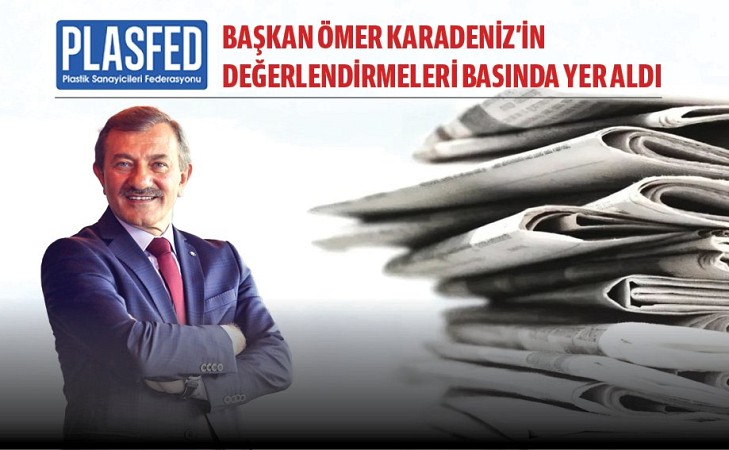
PLASFED President Ömer Karadeniz:
“FOREIGN EXCHANGE CONVERSION SUPPORT
MUST BE STRENGTHENED FOR EXPORTERS' GLOBAL COMPETITIVENESS”
PLASFED Chairman of the Board Ömer Karadeniz stated that Turkey must make foreign exchange conversion support stronger and more holistic in order for exporters to maintain their global competitiveness. Pointing out that China supports its exporters not only through exchange rate policy but also with various tools such as exchange rate risk management, access to finance, tax refunds, and export insurance, Karadeniz said, “As Turkey, we can also create a more comprehensive support model that will reduce the cost and exchange rate pressure on our exporter.”
Stating that Turkish industrialists have recently faced increasing costs and global competitive pressure, Plastics Industrialists Federation Chairman of the Board Ömer Karadeniz said that mechanisms encouraging the conversion of foreign exchange earnings into Turkish liras for the sustainability of exports must also consider the exporter's competitive power.
Recalling that foreign exchange conversion support began to be implemented at a rate of 2 percent in 2023 and was temporarily increased to 3 percent in May 2025, Karadeniz stated that a new era in the implementation began as of October 1, 2026. Pointing out that with the CBRT's new regulation, the support is linked to foreign exchange position, value-added, and supplier companies producing for export, Karadeniz noted that while expanding the scope of the new structure is important, the effectiveness of the support must be increased further in terms of the exporter's global competition conditions.
“The exporter is struggling not only with exchange rates but also with cost pressure”
Stating that Turkey's exporting industrialists are affected not only by exchange rate movements but also by high production costs, financing expenses, and intense price competition in global markets, Karadeniz spoke as follows:
“Today, our exporter competes in global markets not only with the quality of its product, but also with its cost. Numerous cost items, from energy to labor, from financing to raw materials, directly affect our exporter's competitive power. The support provided in the conversion of foreign exchange earnings into TL is also an important tool that supports the exporter's competitive power in this respect. Our expectation is that the foreign exchange conversion support will be raised to a level that will more effectively support the exporter's competitive power.”
“China's approach provides us with an important example”
Stating that different policy tools are used together in supporting exporters in global trade, Karadeniz said that China's practices are remarkable in this respect.
Stating that the use of foreign exchange derivatives and other financial instruments for exporters to manage exchange rate risk has existed in China for a long time and is now even more widespread, Karadeniz expressed that businesses' ability to price and pay in RMB also contributes to the management of exchange rate risk. He also noted that tools such as export tax rebates, export loans, and export credit insurance are used in China to reduce the financial burden and risks of exporters.
Karadeniz said, “We are not talking about directly copying a single support mechanism implemented by China to Turkey here. What matters is that different tools can be used together and effectively to protect the exporter's competitive power. China's approach offers us an important example in this respect.”
“We can create a more holistic export support model”
Emphasizing that Turkey also needs a more holistic support approach that addresses the cost and exchange rate risks faced by the exporter together, Karadeniz continued his words as follows:
“It is not enough to focus on just one support item for our exporter to maintain its competitive power in global markets. In addition to foreign exchange conversion support, access to cost-effective financing, the widespread use of hedging instruments against exchange rate risk, the strengthening of export credit and insurance mechanisms, and the reduction of cost pressure on the exporter must be evaluated together.”
Drawing attention to the importance of industrialists having easier and lower-cost access to financial instruments especially to manage exchange rate risk, Karadeniz stated, “Our exporter needs a financial infrastructure where it can manage exchange rate risk in order to see ahead, give prices, and take long-term orders. In addition, financing access costs need to be brought to competitive levels.”
For more information and contact:
Nilgün Özdemir / [email protected] / 0532 724 95 90
This content has been translated using artificial intelligence technology.